
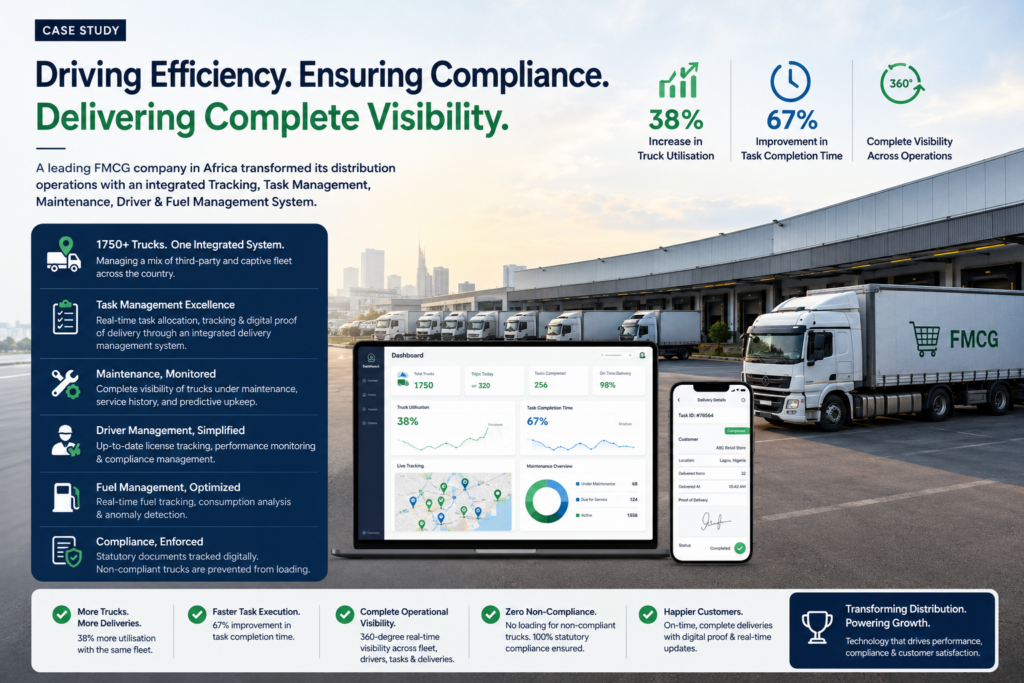
Achieving 360° Visibility Across 1,750 Trucks
Introduction
In the FMCG industry, distribution efficiency is the backbone of business success. Delivering goods quickly, reliably, and cost-effectively across regions requires seamless coordination of vehicles, drivers, compliance, and logistics.
A leading FMCG company in Africa, managing a large mixed fleet of 1,750 trucks (third-party + captive), faced increasing operational challenges due to fragmented systems and limited visibility.
This case study explores how the company transformed its fleet operations by implementing an Integrated Fleet Management Ecosystem—combining tracking, task management, maintenance, driver compliance, and fuel management into a single platform—resulting in measurable business outcomes.
The Challenge: Fragmented Systems and Limited Control
Despite having traditional GPS tracking in place, the company struggled with operational inefficiencies:
🔴 1. Limited Visibility Beyond Location
- GPS tracking showed where trucks were, but not:
- What tasks they were performing
- Delivery status
- Driver behavior
🔴 2. Poor Utilization of Fleet
- Trucks were underutilized due to:
- Inefficient scheduling
- Lack of real-time coordination
- Fleet performance heavily depended on manual planning
🔴 3. Maintenance Blind Spots
- Minimal visibility into:
- Trucks under maintenance
- Downtime duration
- Reactive maintenance led to:
- Unexpected breakdowns
- Increased downtime
Predictive maintenance and monitoring are proven to reduce downtime and improve fleet reliability. [moldstud.com]
🔴 4. Compliance Risks
- Expired:
- Driver licenses
- Regulatory documents
- Risk of:
- Fines
- Operational disruptions
Manual compliance tracking is unreliable and difficult to scale.
🔴 5. No Integration with Delivery Operations
- Delivery tracking was disconnected from vehicle tracking
- No end-to-end visibility from:
- Loading → Transit → Delivery confirmation
The Solution: Integrated Fleet Management Ecosystem
To overcome these challenges, the organization deployed a comprehensive, integrated digital ecosystem, replacing basic tracking with a 360° fleet intelligence platform.
🚀 Core Components of the System
✅ 1. Tracking + Task Management System
- Real-time tracking integrated with:
- Delivery tasks
- Trip assignments
- Each truck linked to:
- A specific delivery job
- Planned vs actual execution
Modern systems combine tracking and workflow control to improve routing and operational efficiency. [agilefleet.com]
✅ 2. Vehicle Maintenance Management System
- Complete visibility into:
- Maintenance schedules
- Vehicle health
- Downtime status
- Enabled:
- Proactive maintenance
- Reduced unexpected breakdowns
Data-driven maintenance helps minimize expenses and improve operational reliability. [agilefleet.com]
✅ 3. Driver Management System
- Centralized tracking of:
- Driver licenses
- Certifications
- Compliance status
Driver management systems help ensure:
- Only qualified drivers operate vehicles
- Compliance is maintained through automated alerts [fleetio.com]
✅ 4. Compliance & Statutory Control
- System automatically validated:
- Vehicle permits
- Regulatory documents
- Trucks with non-compliance:
- Not allowed to load goods
Modern fleet systems automate compliance checks, ensuring audit readiness and reducing risk. [ongraph.com]
✅ 5. Fuel Management System
- Real-time monitoring of:
- Fuel consumption
- Idle time
- Usage patterns
- Enabled:
- Reduction in fuel wastage
- Better cost control
Fuel tracking systems help identify inefficiencies like idle time and route issues, improving cost control and performance. [fleetrabbit.com]
✅ 6. Integrated Delivery Management System
- End-to-end tracking:
- Dispatch → Transit → Delivery
- Real-time updates on:
- Delivery completion
- Delays
- Full visibility for stakeholders
The Results: Measurable Transformation
The deployment delivered strong operational and financial impact:
📈 38% Increase in Truck Utilization
- Better scheduling and task allocation
- Reduced idle fleet time
- Optimized asset usage
Fleet optimization technologies are known to significantly improve utilization through better scheduling and monitoring. [moldstud.com]
⚡ 67% Improvement in Task Completion Time
- Faster delivery execution
- Real-time coordination with drivers
- Reduced delays
🔧 Enhanced Maintenance Visibility
- Full transparency into:
- Vehicles under repair
- Expected downtime
- Reduced unexpected breakdowns
✅ 100% Driver Compliance Visibility
- Automatic tracking of:
- License validity
- Certifications
- Prevented unqualified drivers from operating vehicles
📄 Automated Compliance Enforcement
- Trucks without valid documents:
- Restricted from loading
- Reduced regulatory risks and penalties
⛽ Optimized Fuel Efficiency
- Visibility into fuel usage patterns
- Reduced wastage due to:
- Idle time
- Inefficient routes
Fuel monitoring systems have demonstrated the ability to significantly reduce fuel inefficiencies and cost leakages. [fleetrabbit.com]
👁 360° Operational Visibility
- Real-time view of:
- Trucks
- Drivers
- Deliveries
- Maintenance
- Enabled data-driven decision-making
Why This Transformation Worked
The success of this implementation lies in integration and intelligence:
1. From Tracking → to Operational Control
- Not just “Where is the truck?”
- But:
- What is it doing?
- Is the task completed?
2. From Reactive → to Predictive Operations
- Maintenance and compliance handled proactively
- Reduced risk and downtime
3. From Siloed Systems → to Unified Platform
- Connected:
- Fleet
- Drivers
- Fuel
- Maintenance
- Deliveries
Key Takeaways for FMCG & Logistics Leaders
✔ Go Beyond GPS Tracking
Tracking alone does not deliver efficiency—integration does.
✔ Build a Unified Fleet Ecosystem
Combine:
- Tracking
- Tasks
- Maintenance
- Compliance
✔ Use Data for Optimization
Visibility → Insights → Efficiency.
✔ Enforce Compliance Digitally
Automated checks eliminate risk and manual errors.
✔ Focus on End-to-End Visibility
From dispatch to delivery—every step matters.
Conclusion: From Fleet Tracking to Fleet Intelligence
This FMCG company’s journey demonstrates a critical evolution:
From basic vehicle tracking → to intelligent fleet management
By integrating all aspects of fleet operations into a single platform, the organization achieved:
- 38% higher utilization
- 67% faster task completion
- Complete operational visibility